// The Incident
On March 12, 2026, a fire broke out in the main laundry areas of the USS Gerald R. Ford (CVN-78) while the carrier was operating in the Red Sea in support of Operation Epic Fury — the ongoing US-Israeli military campaign against Iran. Three sailors suffered non-life-threatening injuries. The Navy stated the fire was fully contained the same day and that the ship remained “fully operational.”
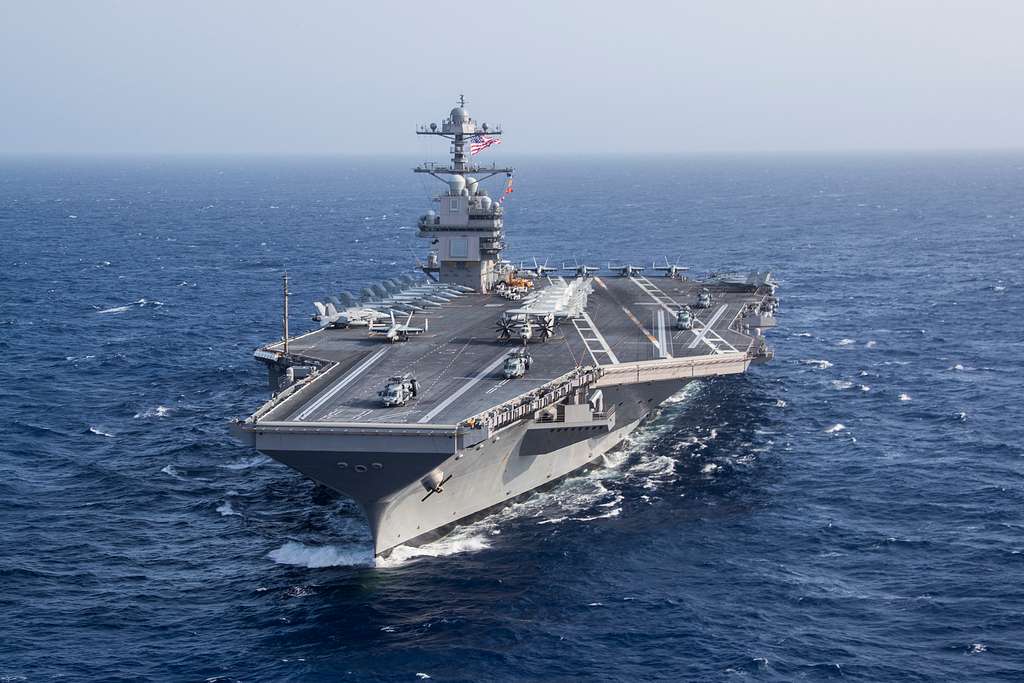
Those statements were quickly contradicted by reporting and an unauthorized video from a crew member. The New York Times reported that more than 600 sailors were displaced by the fire, sleeping on floors and tables. It took more than 30 hours to fully extinguish — not hours, as initially suggested. The Navy Exchange liquidated its inventory of boots at several European bases to resupply Ford’s crew, suggesting significant loss of personal gear. The carrier subsequently departed the Red Sea for repairs at Naval Support Activity Souda Bay in Crete, Greece.
Iran claimed responsibility for the incident. The US Navy has not confirmed or denied the Iranian claim, stating only that the cause is under investigation.
// What the Evidence Shows
Naval fire experts interviewed by Stars and Stripes described aircraft carrier laundry facilities as a concentration of industrial-scale hazards — powerful dryers running at capacity around the clock, enormous electrical loads, lint accumulation in filters, and thousands of pounds of combustible fabric. Sal Mercogliano, an adjunct professor at the US Merchant Marine Academy, described the environment as “a smorgasbord of danger all put together.”
The Ford had been at sea continuously since late June 2025 — nearly nine months — an unusually extended deployment that included the Caribbean, the Mediterranean, and the Red Sea. Extended sea time means equipment runs past normal service intervals, maintenance is deferred, and mechanical failure rates increase. This context is consistent with an accidental fire.
It is also consistent with a targeted attack. Iranian forces have demonstrated the capability and intent to strike US naval assets asymmetrically — through drone swarms, anti-ship missiles, and naval mines. An attack on a non-combat space like a laundry facility, deep in the ship’s lower decks, would produce exactly the kind of ambiguous damage profile the Ford incident presents: significant crew displacement, operational disruption, and a plausible accidental explanation that gives both sides reason to avoid escalation.
The unauthorized video showing a major fire in the vicinity of the laundry spaces — larger than a dryer fire would typically produce — has not been officially addressed by the Navy.
// The Strategic Picture
The Ford’s withdrawal from the Red Sea has immediate operational consequences. The carrier and its strike group have been conducting hundreds of combat sorties daily as part of Operation Epic Fury. CENTCOM reported more than 8,000 combat flights since the campaign launched February 28. The Ford’s departure reduces US strike capacity in the theater at a critical moment.
The USS George H.W. Bush (CVN-77) has now departed Naval Station Norfolk, Virginia, on a deployment widely understood to relieve the Ford. The Bush strike group’s deployment represents a continuation of US carrier presence in the European and Middle Eastern theaters — but it also means Norfolk, already the world’s largest naval station, has temporarily reduced its carrier force while the Bush is in transit and the Ford is undergoing repairs.
This is the operational reality of sustaining a carrier war: the US has 11 carriers, but only a fraction are deployable at any given time. Extended combat deployments accelerate wear, increase accident rates, and compress the maintenance cycles that keep these irreplaceable assets operational.
// What This Means for Homeland Communities
Naval Station Norfolk, homeport of both the Ford and the Bush, is the most concentrated naval infrastructure in the world. Disruptions to carrier operations — whether from combat damage, accident, or Iranian asymmetric action — directly affect the communities surrounding Norfolk, including Hampton, Newport News, and Virginia Beach. These communities house tens of thousands of Navy families whose service members are now operating in an active combat zone.
The Ford incident also illustrates the compounding risk of extended deployments: equipment failures, crew fatigue, deferred maintenance, and reduced readiness accumulate over time in ways that are difficult to see from the outside. For communities near major naval installations, understanding the operational tempo of deployed carriers is part of situational awareness during a period of active US military engagement.
// Key Facilities
- Naval Station Norfolk VA — homeport of USS Gerald R. Ford and USS George H.W. Bush
- Naval Station Norfolk VA — world’s largest naval base, currently reduced carrier presence
- NSA Souda Bay, Crete — current location of USS Gerald R. Ford for repairs
- MacDill AFB Tampa FL — CENTCOM headquarters commanding Operation Epic Fury
// Sources
Stars and Stripes, March 18, 2026 · US Central Command public statements · New York Times reporting on crew displacement · USNI News on Ford’s departure from Red Sea · US Navy official statements, March 12-18, 2026.